
Speakers
-
 Astha AgarwallaAssociate Professor and Program Chair (MBA in Urban Management) at CEPT University
Astha Agarwalla is Associate Professor and Program Chair (MBA in Urban Management) at CEPT University. An urban economist by training, her research focuses on the intersection of markets and urban development. She holds a PhD in Public Systems from IIM Ahmedabad, where her work examined the impact of urbanisation and infrastructure investments on productivity growth across Indian states.
-
 Dr. Ravikant JoshiSenior Fellow (Senior Finance & Governance) CPPR, Former Chief Accounts Officer, Vadodra Municipal Corporation
Dr. Ravikant Joshi is an Urban Finance and Management specialist and has worked in India and abroad. He is former chief accounts officer of Vadodara Municipal Corporation with more than 35 years of experience. He was responsible for the conceptualisation, designing and implementation of Municipal Financial, Budgetary and Accounting System Reforms and their computerization in Vadodara Municipal Corporation.
• At present since August 2019, Dr. Joshi is working as an Advisor to Urban Management Centre – Ahmedabad, also he is working as a freelance consultant.
• 2017 to 2019 Dr. Joshi worked as a Team Leader – Technical Support Group to National Urban Livelihood Mission – Ministry of Housing and Urban Affairs – Government of India
• Dr. Ravikant Joshi worked as an Advisor – Urban to CRISIL Risk and Infrastructure Solutions, Mumbai from 2002 to 2017.
• He has worked as a short-term consultant (STC) for multilaterals like World Bank, Water & Sanitation Program, ADB, USAID, DFID, UN Habitat, CLGF and for various national/state level organisations on urban issues.
• He conceived, designed and spearheaded implementation of Accrual Base Double Entry Accounting System in 159 municipal bodies of Gujarat. -
 Hitesh VaidyaUrban Practitioner and former Director of NIUA
Hitesh Vaidya is a distinguished urban development practitioner with over 25 years of experience in policy design, project formulation, and large-scale program management. He has worked extensively with global development institutions including the United Nations, World Bank, and USAID, contributing to transformative initiatives in urban governance, infrastructure management, and inclusive poverty alleviation.
Prior to joining the National Institute of Urban Affairs, he served as Country Representative of UN-Habitat India, where he played a pivotal role in shaping the ecosystem for the design and rollout of India’s flagship urban missions. Renowned for his strategic leadership, he excels in building robust institutional frameworks and driving effective project implementation through strong coordination among governments, multilateral agencies, and diverse stakeholders.
Local Time
- Timezone: America/New_York
- Date: Apr 06 - 07 2026
- Time: 8:30 pm - 10:30 am
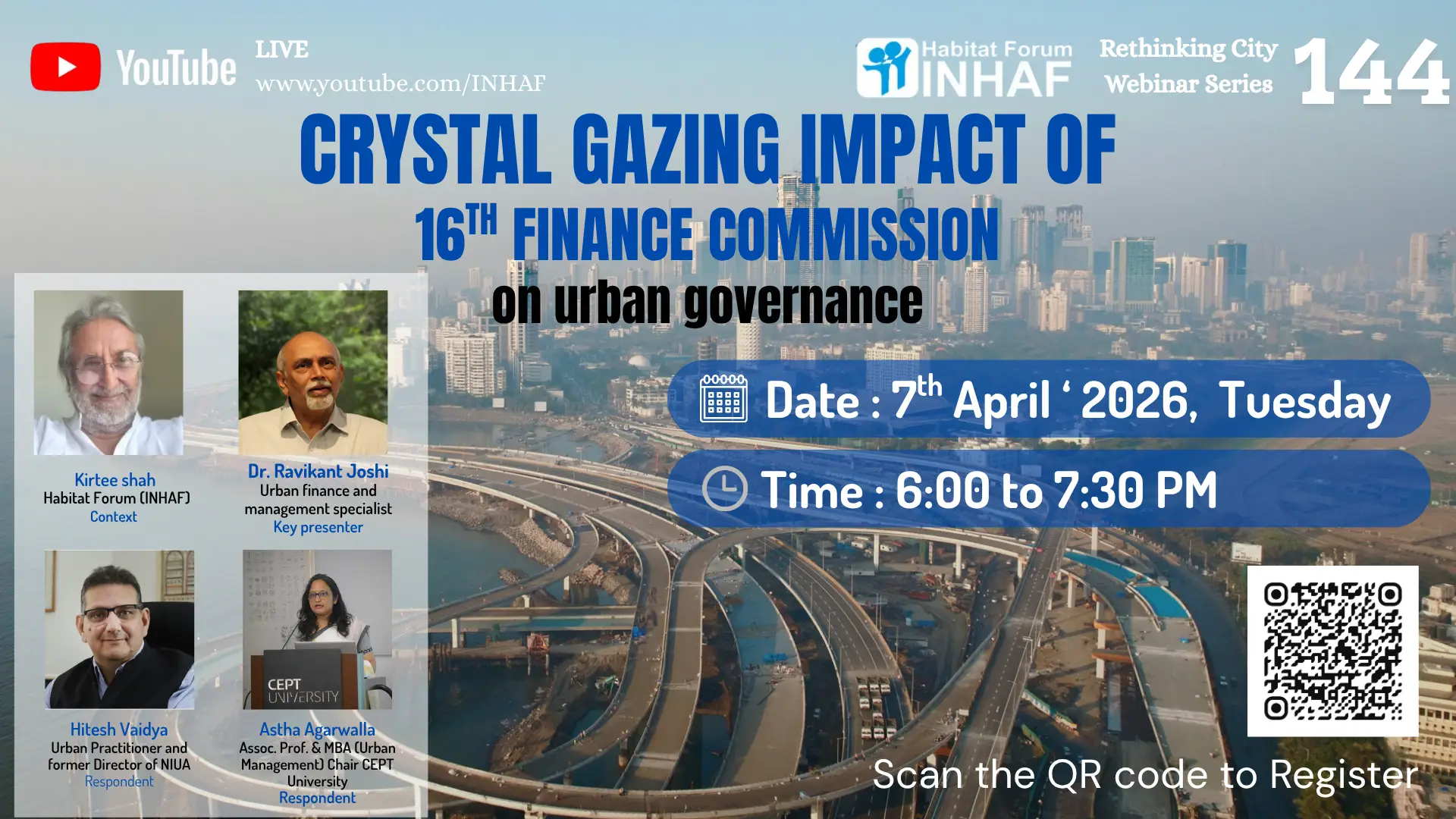
Crystal Gazing Impact of 16th Finance Commission on Urban Governance
With rapid urbanisation placing increasing pressure on cities, the role of fiscal federalism in strengthening urban governance has become more crucial than ever. The forthcoming recommendations of the 16th Finance Commission present an important opportunity to reassess and reshape the financial architecture supporting urban local bodies in India.
Past Finance Commissions have progressively recognised the importance of urban governance by allocating funds directly to municipalities and incentivising reforms in areas such as property tax, service delivery, and financial management. However, challenges remain in ensuring adequacy, predictability, and effective utilisation of these funds, alongside strengthening local capacities.
This session aims to “crystal gaze” into the potential directions and implications of the 16th Finance Commission’s recommendations. It will explore how fiscal transfers, performance-linked incentives, and institutional reforms could influence urban governance, accountability, and service delivery. The discussion will also reflect on how cities can better position themselves to leverage these opportunities and build more resilient, responsive, and financially sustainable urban systems.