India’s urban growth trajectory
India’s urban development has seen a slew of schemes beginning with Jawaharlal Nehru National Urban Renewal Mission (JNNURM) in 2005 which focused on 65 large mission cities under its primary sub-missions (Urban Infrastructure and Governance, and Basic Services to the Urban Poor), while hundreds of other small and medium towns and cities received funding through its separate companion schemes, Urban Infrastructure Development Scheme for Small and Medium Towns (UIDSSMT) and Integrated Housing and Slum Development Programme (IHSDP). This was replaced in 2015 by the Smart Cities Mission (SCM) and Atal Mission for Rejuvenation and Urban Transformation (AMRUT) which focused on 100 large cities and 500 small cities each. Housing and public works undertaken through other overlapping schemes like Pradhan Mantri Awas Yojana, Urban (PMAY-U), Swachch Bharat Mission (SBM), and National Urban Livelihoods Mission (NULM) also contributed to urban infrastructure development. The lack of census data notwithstanding, according to Economic Survey 2025-26, India’s urbanization rate has been more prolific than official estimates. As per satellite data from the Global Human Settlements Layer (GHSL) of the Group on Earth Observations at the European Commission, India was 63 per cent urban in 2015, which is nearly double the urbanisation rate reported in the 2011 Census (PIB, 29 Jan 2026). The Economic Survey maintained that the World Bank also estimated that by 2036, India’s towns and cities will be home to 600 million people, or 40 per cent of the population, up from 31 per cent in 2011, with urban areas contributing almost 70 per cent to GDP (PIB, 29 Jan,2026). India’s goal of becoming a developed nation by 2047, the year of its 100th year of independence, will be largely dependent on how effectively it handles this urban transition.
Building the required infrastructure will, in fact, be crucial to developing inclusive, liveable, and climate-resilient communities that boost the economy. Large investments will be necessary as 70% of the urban infrastructure required by 2047 has not yet been constructed. India would require $840 billion in infrastructure investment by 2036, or $55 billion or 1.2 percent of GDP annually on average. However, estimates indicate that the nation’s overall capital expenditure on urban infrastructure averaged only 0.6 percent of GDP between 2011 and 2018, which is half the amount of investment needed (World Bank, 2022).
Growth of small towns in India
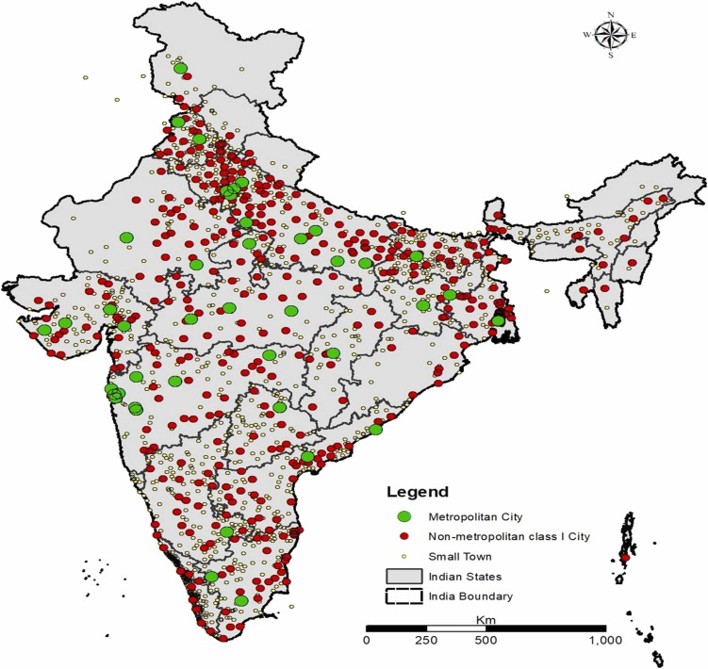
Secondary cities (Tier 2 and Tier 3 cities) in India play a key role in the economy, contributing about 37% of the country’s GDP and are home to over half of India’s Micro, Small, and Medium Enterprises (MSMEs) (World Economic Forum, 2025). They help reduce regional inequalities by providing economic chances beyond overcrowded megacities, easing infrastructure strain and lowering living costs. These cities are also rising as centers of innovation, with 50-58% of startups and new MSMEs coming from non-metro areas (PIB, 15 Jan 2026) Factors driving this growth include market saturation in bigger cities and lower costs in smaller ones. Access to skilled labor from local educational institutions and the growing middle class create large market opportunities. Moreover, the digital revolution, characterized by improved infrastructure, increased internet usage, and the spread of digital payment systems like UPI, supports economic growth in these regions (Mikro Grafeio post, May 2025). The cluster analysis by Mitra and Tripathi shows that almost 90% of the small towns have developed due to their proximity to a large city with a population of 5 lakh or more and the availability of infrastructure (water supply, electricity connections, latrines, and hospitals) plays a crucial role in their emergence.
Places such as Sattenapalle in Andhra Pradesh, Dhamtari in Chhattisgarh, Barabanki in Uttar Pradesh, Hassan in Karnataka, Bongaigaon in Assam, and Una in Himachal Pradesh have transformed into logistics centers, agro-processing hubs, warehouse towns, construction economies, service centers, and consumption markets. These towns are absorbing migrant workers displaced from metropolitan areas and rural youth with limited agricultural opportunities. Contrary to being outside the urban framework, these small towns are integral to it. They are urbanized under capitalist pressures, characterized by affordable land, flexible labor, lax regulations, and limited political oversight (IMPRI Insights, Feb 2026).
Lop sided regional development and migration
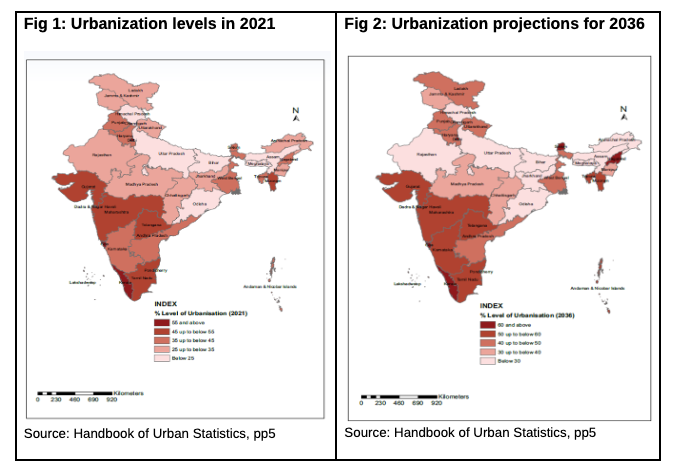
The historical devolution of funds to urban local bodies by the 16th Finance Commission as well as provisions like the Urban Challenge Fund have been taken up by the government to stimulate urban development. This is a welcome move; however, the question that arises is where this development will take place. According to the Handbook of Urban Statistics, 2022, the large states in Central and Eastern India (Madhya Pradesh, Chattisgarh, Uttar Pradesh, Bihar, Orissa, and Jharkhand) along with Rajasthan, Himachal Pradesh, parts of Jammu and Kashmir, and four North- eastern states (Arunachal Pradesh, Assam, Manipur, and Meghalaya) together are not expected to cross 40% urbanization even 10 years from now. This means that almost half of the country would not have achieved 50% urbanization even by the end of the next decade.
Further, according to the India Employment Report, 2024, these states are also host to over 50% of the youth population (18-25 years) and that is not expected to decline in the next 10 years (ILO, pp 288). The states of Uttar Pradesh, Bihar, Madhya Pradesh and Rajasthan especially have very high levels of youth population. This cohort also has very low levels of education and skills (ILO 2022, pp 35). Further, the youth population in the more urbanized states (South and West) shows a declining trend (it is expected to reduce by nearly 20 million) up to 2036. On the other hand, the youth population in lesser urbanized states is expected to remain 200 million up to 2031 and is expected to decline by barely 5 million by 2036 (ILO, pp 288).
In the absence of development and non-farm alternatives there is then large- scale distress migration from the Central and Eastern regions to the South, Western, and Northern regions of India. The metros and large cities in these regions are already saturated and their infrastructure is finding it increasingly difficult to cater to the needs of the burgeoning urban population. Under such circumstances, rethinking urban planning in terms of balanced regional development is critical for sustainable, long-term growth.
Creating urban livelihoods
An urban employment guarantee scheme for the alleviation of the urban unemployment crisis being faced by the country, particularly by the youth and women is an idea whose time has come. Such a scheme would not be just an employment generation initiative but a tool for kickstarting the development of smaller cities which will help in regulating migration and also lead to balanced regional growth. The creation and maintenance of civic infrastructure (WASH facilities, electricity, transport and communication networks, footpaths, waste management), climate resilient infrastructure (stormwater drainage, waterbody rejuvenation, urban greening, coastal ecosystem restoration), and social infrastructure (affordable housing, schools, hospitals, parks, cultural centres, hostels, libraries, sports complexes, disaster shelters, orphanages, and senior citizen centres) will not only create durable assets for the citizens but also provide essential non-farm livelihoods in surrounding rural areas.
As improved infrastructure attracts investments and creates jobs across industries and services, the virtuous cycle of higher income, output, and employment can be kickstarted. This is turn will promote the high rate of GDP growth required to take India to middle income country status. The expenditure on the scheme should therefore not be viewed as a recurring revenue expenditure. Instead, it is much needed capital investment in creating urban infrastructure while also generating employment in the process. It is also an opportunity to invest in educational and health outcomes which has been the bane of Indian economy over the decades. The example of China in this regard is worth emulating – their massive investment in human resources has paid rich dividends over the last three decades (Liang and Shuang, 2013). However, again borrowing a leaf from the Chinese (and Japanese examples) which are struggling with an ageing population, the scheme would also offer a possibility for investing in care infrastructure for the elderly. This can also include child care infrastructure for promoting greater participation of women in the workforce.
The Scheme could also include migrants in the works undertaken by ULBs and provide for indexed minimum wages which will have an impact on the informal sector wages. Rural India is more egalitarian and the quality of life better than the slums where migrants are forced to take shelter in the cities when they come in search of jobs. In such a scenario, developing small towns will not only help in tackling migration and balanced regional development but also result in providing a better quality of life to workers who would otherwise have migrated to urban slums. As mentioned earlier, 70% of the urban infrastructure is yet to be created. This 70% opportunity can be an inflection point in India’s development story if livelihoods are created with a focus on balanced regional development.
References:
- Handbook of Urban Statistics, 2022. NIUA. Retrieved from: https://niua.in/intranet/sites/default/files/2802.pdf
- India Employment Report, 2024. ILO. Retrieved from https://www.ilo.org/sites/default/files/2024-08/India%20Employment%20-%20web_8%20April.pdf
- Mitra, A. and Tripathi, S. (2021). Shedding light on unnoticed gems in India: Small towns’ development perspective. IEG Working Paper No. 437. Retrieved
from: https://iegindia.org/upload/profile_publication/doc-030821_213435WP437.pdf - Liang, Xiaoyan, and Shuang Chen. (2013). Developing Skills for Economic
Transformation and Social Harmony in China: A Study of Yunnan Province.
Washington, DC: World Bank. doi:10.1596/978-1-4648-0079-5. License: Creative
Commons Attribution CC BY 3.0 - https://www.pib.gov.in/PressReleasePage.aspx?PRID=2219926®=48&lang=2
- https://www.pib.gov.in/PressReleasePage.aspx?PRID=2214872&lang=1®=3
- .https://www.worldbank.org/en/news/press-release/2022/11/14/india-s-urban-infrastructure-needs-to-cross-840-billion-over-next-15-years-new-world-bank-report
- https://www.weforum.org/stories/built-environment-and-infrastructure/investing-smaller-cities-emerging-economies-boost-global-growth
- https://www.impriindia.com/insights/urbanisation-in-indias-small-towns/
- https://www.mikrografeio.com/post/unlockingthepotentialofindia-ssmallcities-jobs-innovation-andsustainability